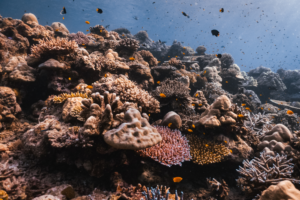
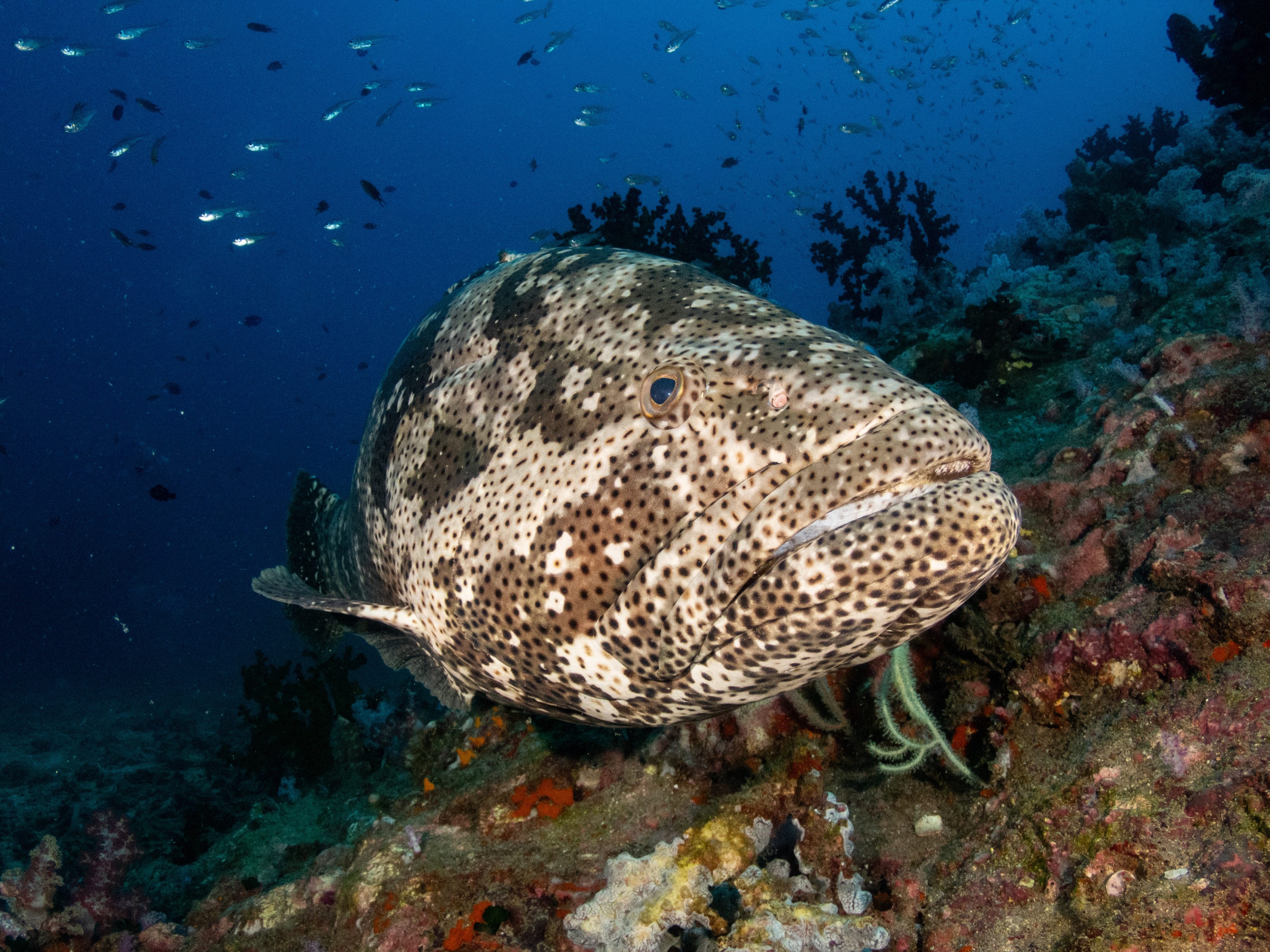
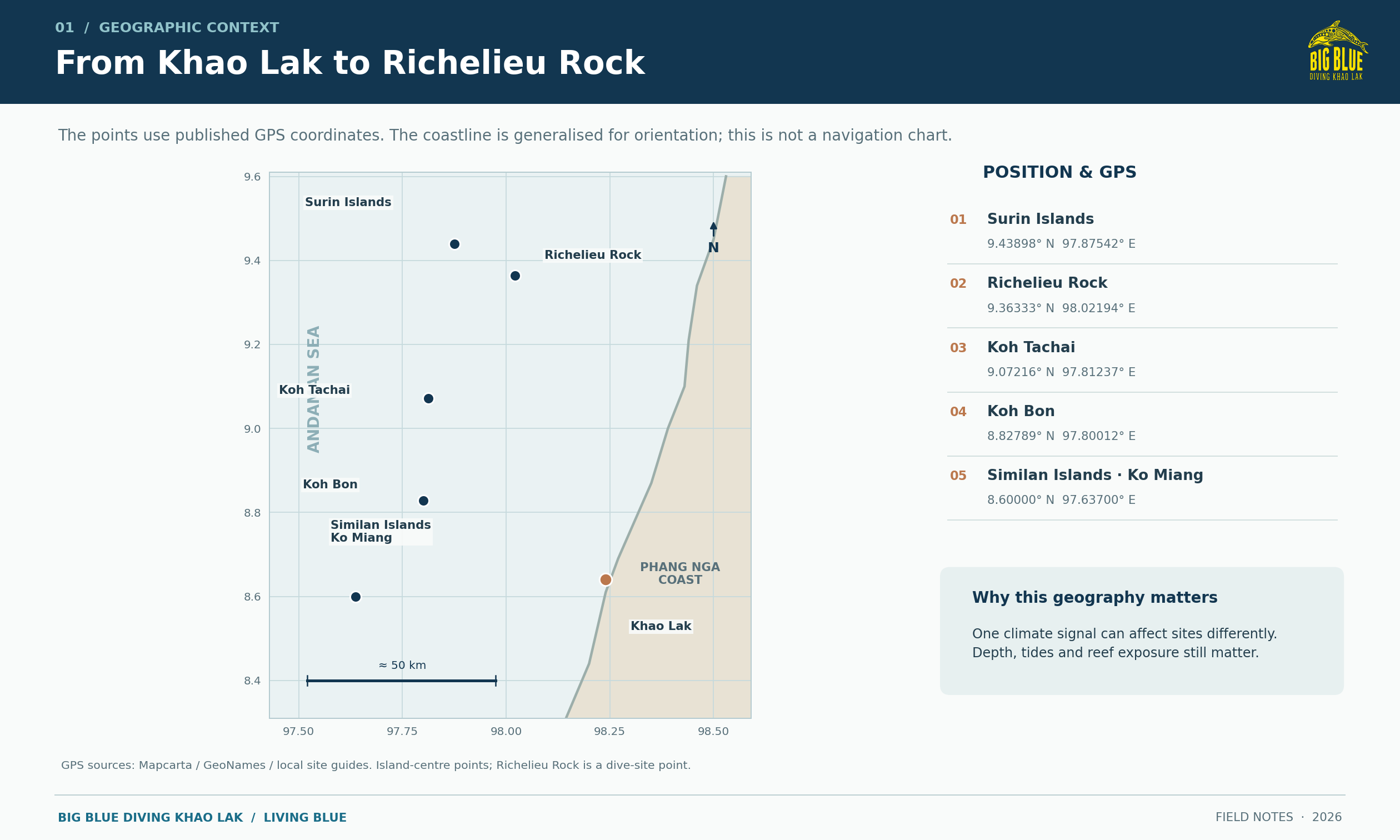
I’ve spent a lot of years diving around the Similan Islands, Koh Bon, Koh Tachai, Surin and Richelieu Rock. One thing I’ve learnt is that what’s happening on the surface doesn’t necessarily tell you what’s happening 20 or 30 metres below it.
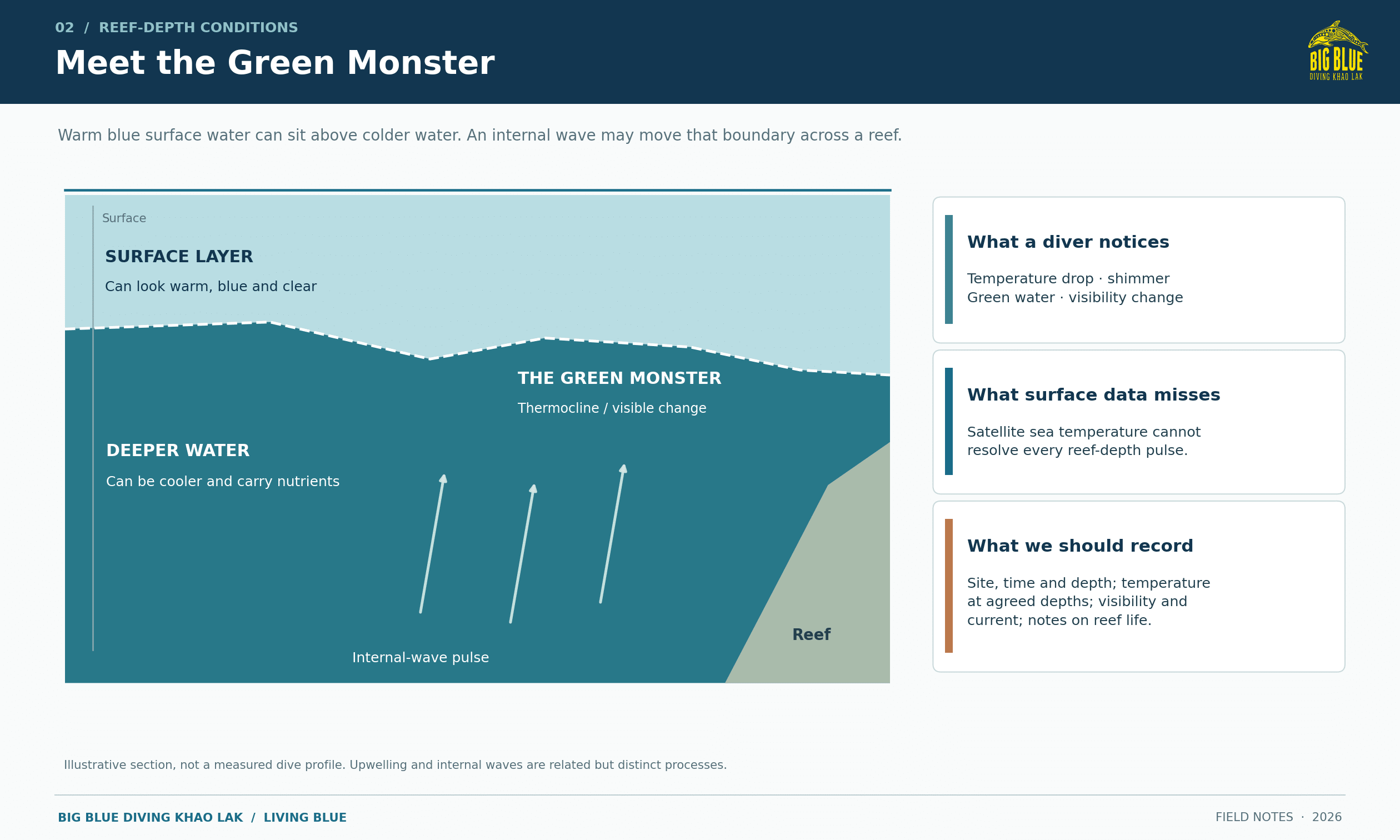
We can leave Khao Lak with beautiful weather, arrive at a site with warm blue water at the surface, then swim into something completely different halfway through the dive. The temperature drops. The water turns green. Visibility changes. Sometimes you can see the boundary moving across the reef.
At Big Blue we call it the Green Monster. It’s cold, green and sometimes a bit gnarly. We love it too, because these changes can bring productive water and plenty of life. Over the years, some of my most memorable marine-life activity has happened around those changes. That doesn’t mean a Green Monster guarantees a manta or a whale shark. It means I don’t judge a dive by how blue the water looks at the surface.
With El Niño strengthening in the Pacific and the possibility of a positive Indian Ocean Dipole, or IOD, developing closer to us, I’ve been reading more about the processes behind what we see. I think this season could be interesting – and I’d like us to record what actually happens underwater.
First, what is El Niño?
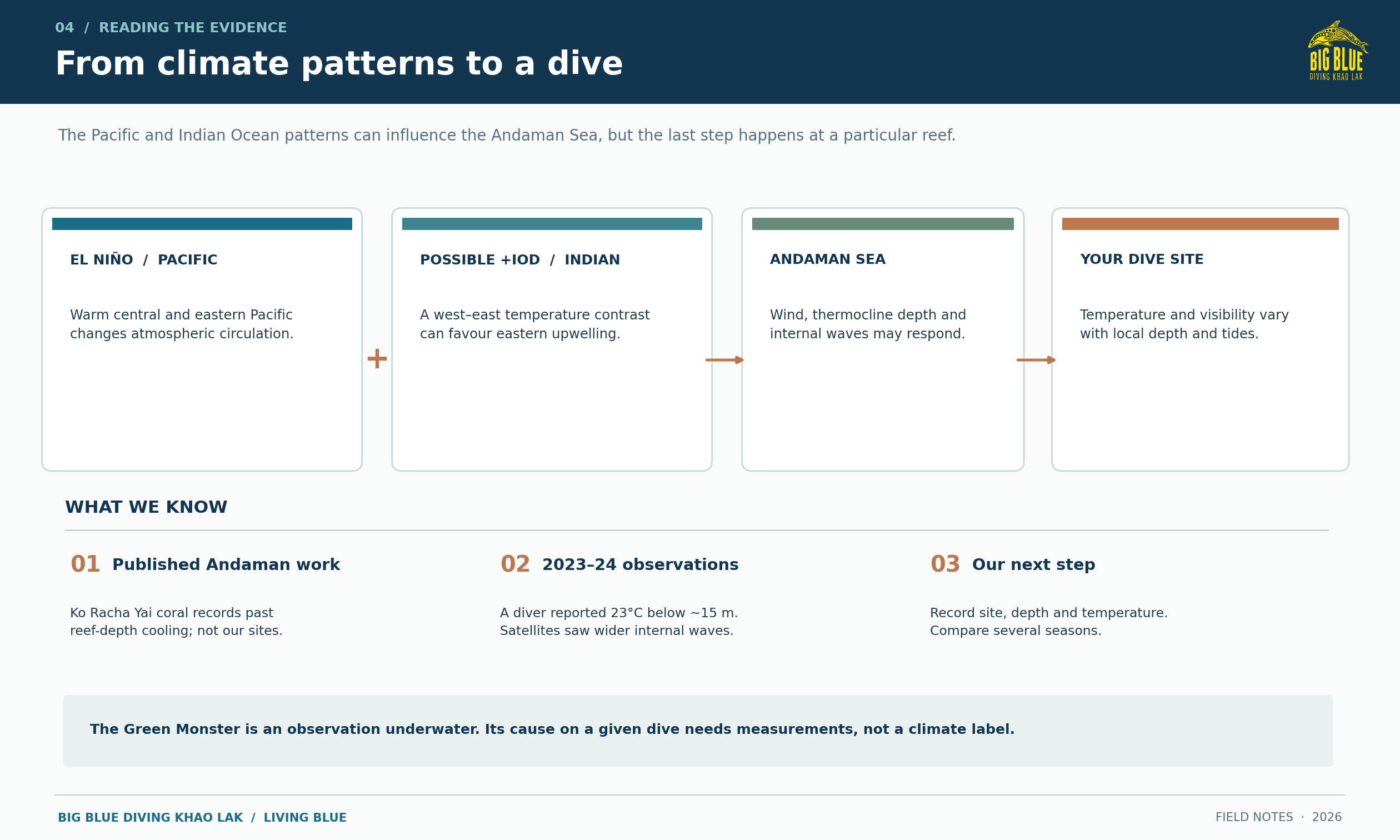
El Niño is part of a natural climate pattern called the El Niño–Southern Oscillation, or ENSO. During its warm phase, parts of the central and eastern tropical Pacific become warmer than usual. The atmosphere and winds respond, with effects that can reach far beyond the Pacific.
In its 10 September 2026 outlook, NOAA said El Niño was strengthening and estimated a greater than 90% chance of a very strong event during the Northern Hemisphere autumn and winter of 2026–27. Its September forecast put the probability of El Niño at 100% for the January–March three-month period. Those are forecasts, not a promise about conditions on any particular dive day. [1, 2]
The Indian Ocean has its own pattern
The Indian Ocean Dipole describes a temperature difference between the western and eastern tropical Indian Ocean. During a positive IOD, water tends to be warmer than usual in the west, towards Africa, and cooler than usual in the east, towards Indonesia. Changes in the winds can allow cooler water to rise in the eastern Indian Ocean. That upward movement is called upwelling. [3]
The Australian Bureau of Meteorology said on 15 September that the IOD was still neutral. The weekly index for the week ending 13 September was +0.65°C, above its +0.4°C positive threshold, but one reading does not establish an event. Its models suggested a positive IOD was likely to develop, while the strength and duration remained uncertain. [4]
So I’m watching the IOD. I’m not calling it a positive event yet.

What does the Andaman research tell us?
A 2026 study caught my attention because it used the chemistry in a coral skeleton to reconstruct past temperatures at reef depth in the Andaman Sea. The coral came from Ko Racha Yai, near Phuket, rather than from our usual northern dive sites. The researchers found strong episodes of subsurface cooling, especially in the combined positive IOD and El Niño event of 1997/98. A shallower thermocline and internal waves helped move cooler water onto the reef. Some of that cooling was not apparent in satellite sea-surface temperature records. [5]
Other cooling episodes in that record coincided with combined events in 1994/95 and 2006/07, although a 1999/00 episode occurred during La Niña. The paper describes the strongest seasonal influence of large internal waves and reef cooling around January to March. It gives us a useful mechanism to investigate, but it doesn’t tell us exactly what will happen at Richelieu Rock, Koh Tachai or any other individual site this season. [5]
That is where repeated observations by people who actually dive these waters could be useful.

A recent season I keep coming back to
The 2023–24 season is a good example of why I want better records. I remember some notably cold, green dives. It wasn’t just our team talking about it. A diver writing about a December 2023 Similan trip on Blue Dolphin recorded water down to 23°C below roughly 15 metres and described meeting the Green Monster. When the same diver returned in February 2024, he said the water was warmer, although several dives still had green water and strong currents. Another Similan operator has also described cooler, greener conditions in late 2023 and early 2024. [7, 8, 9]
There is a separate scientific record from that period. A satellite study of the wider Andaman Sea found frequent large internal waves in observations from July 2023 to March 2024, including a particularly large event in March. Internal waves are one way deeper water can reach reef depth. But those satellite observations don’t give us a temperature reading for Richelieu or prove what caused the cold water on any one of our dives. [10]
So I can say we experienced cold water, and other divers recorded it too. I can’t yet put a number on how unusual the whole season was compared with other years. That gap is exactly what I’d like us to start filling.
Meeting the Green Monster
A thermocline is the transition between warmer water above and cooler water below. Sometimes the change is gentle. Sometimes you swim through a visible shimmer and suddenly feel several degrees of difference. The colder layer can also look green and reduce visibility. That’s the Green Monster as our team knows it.
There are several ways cooler water can reach a reef, including upwelling and internal waves. A green thermocline on one dive isn’t, by itself, proof that the IOD or El Niño caused it. Wind, tides, currents, topography and local conditions matter too. But a consistent record across many dives may help us see patterns that memory alone misses.

What might this mean for your diving?
We’re not predicting poor visibility for the season, or promising big-animal encounters. Conditions can vary between sites, depths and even consecutive dives. Our guides assess the conditions, choose suitable sites and brief you on what to expect. If a Green Monster rolls through, you may meet a cold, green patch and a lively reef in the same dive. We’ll help you enjoy the ocean we actually have that day.
Why green water can be full of life
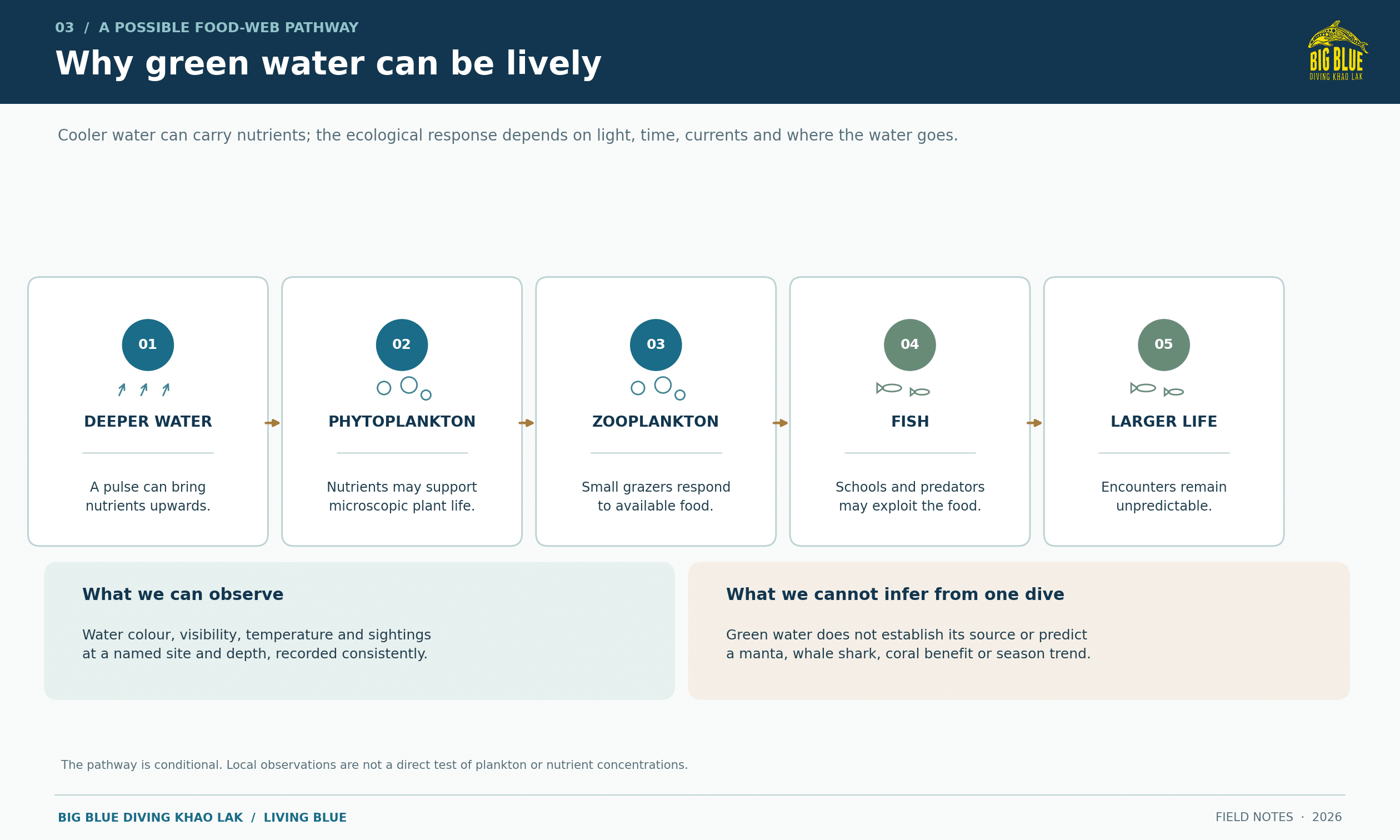
When deeper water rises, it can bring nutrients into shallower layers. Nutrients can support phytoplankton, which helps feed zooplankton and the wider food web. A study of the strong 2019 positive IOD documented increased chlorophyll, a measure linked to phytoplankton, in parts of the eastern tropical Indian Ocean. That is evidence of a broader mechanism, not a measurement at our dive sites. [6]
I’ve seen plenty of fish activity around changing water here, and I think that connection is worth exploring. But I can’t turn it into a formula such as El Niño equals whale sharks or a positive IOD equals mantas. Sightings depend on many things, and we’d need careful records before making even a local association.

There is another side to the story
Corals face growing heat stress. Cooler intrusions can sometimes offer reefs temporary relief, and the Andaman study describes the region as a potential thermal refuge. The researchers also found that the effect varied across time and place. A reef at one depth may cool while another remains exposed to heat. Cold water isn’t an automatic solution to warming seas. [5]
What do I think will happen this season?
I don’t know.
NOAA expects a very strong El Niño. A positive IOD remained a possibility in the 15 September Australian outlook. Research shows that large-scale climate patterns can influence cooling at reef depth in the Andaman Sea. My own experience makes me particularly curious about the Green Monster and the marine activity around it. Those are different kinds of evidence, and I want to keep them separate.
Rather than saying, “It seemed colder this year,” or “There seemed to be more plankton at Richelieu,” I’d like us to begin writing things down consistently.
The Big Blue Andaman Sea Watch
This season, the idea is to record the same basic details on our dives: site, date and time; temperature at agreed depths; where a thermocline begins and how strong it feels; visibility, current and water colour; and noteworthy coral and marine-life observations. We can record when we meet the Green Monster, the depth of the change and what we see around it.
The team can make the core environmental record. Guests who want to join in could add sightings, behaviour and photographs. We’d develop that side through our Living Blue Project. We’re working out the practical method, so I don’t want to pretend that a fully fledged research programme is already running.
One week may tell us little. A season could give us a starting point. Several seasons, with the same methods, might allow useful comparisons between places and years. I’d welcome advice from researchers on how to make those observations more valuable.
Maybe we’ll prove ourselves wrong
I’ve developed my own beliefs about cold water, thermoclines, plankton and marine life after years of diving here. Some published research gives those observations a possible explanation. I don’t want us to collect data to prove an idea I’ve already made up my mind about. I want to find out.
Maybe we’ll see a pattern. Maybe we won’t. Maybe something else will emerge. After more than 20 years of operating here, the ocean still surprises us, and I rather hope it always will.
This season we’re going to pay a little more attention — and write it down.
Steve Boot
Big Blue Diving Khao Lak
Living Blue Project
Research and further reading
1. NOAA Climate Prediction Center, ENSO Diagnostic Discussion, 10 September 2026: https://www.cpc.ncep.noaa.gov/products/analysis_monitoring/enso_advisory/ensodisc.shtml
2. NOAA Climate Prediction Center, official ENSO probabilities, September 2026: https://cpc.ncep.noaa.gov/products/analysis_monitoring/enso/roni/probabilities/
3. Australian Bureau of Meteorology, The Indian Ocean Dipole: https://www.bom.gov.au/resources/learn-and-explore/climate-knowledge-centre/climate-factors/indian-ocean-dipole
4. Australian Bureau of Meteorology, Southern hemisphere monitoring, issued 15 September 2026: https://www.bom.gov.au/climate/enso/
5. Camelia and colleagues, “Tropical climate modes control strength and distribution of thermal stress mitigation in a coral reef refugia”, Scientific Reports (2026): https://www.nature.com/articles/s41598-026-52941-6
6. “A biological Indian Ocean Dipole event in 2019”, Scientific Reports (2021): https://www.nature.com/articles/s41598-021-81410-5
7. Dive Happy, “Similan Islands Liveaboard Trip Report December 2023”: https://divehappy.com/similan-islands-liveaboard-trip-report-december-2023/
8. Dive Happy, “Similan Islands Liveaboard 15–19 February 2024”: https://divehappy.com/similan-islands-liveaboard-15-19-february-2024/
9. Similan Diving Tours, “The best time to dive Similan Islands”, water temperature section: https://www.similandivingtours.com/blog/blogs/information/the-best-time-to-dive-similan-islands
10. Mandal and colleagues, “Internal Wave Characteristics in the Andaman Sea: New Insights From SWOT Observations”, Geophysical Research Letters (2026): https://agupubs.onlinelibrary.wiley.com/doi/10.1029/2026GL122284