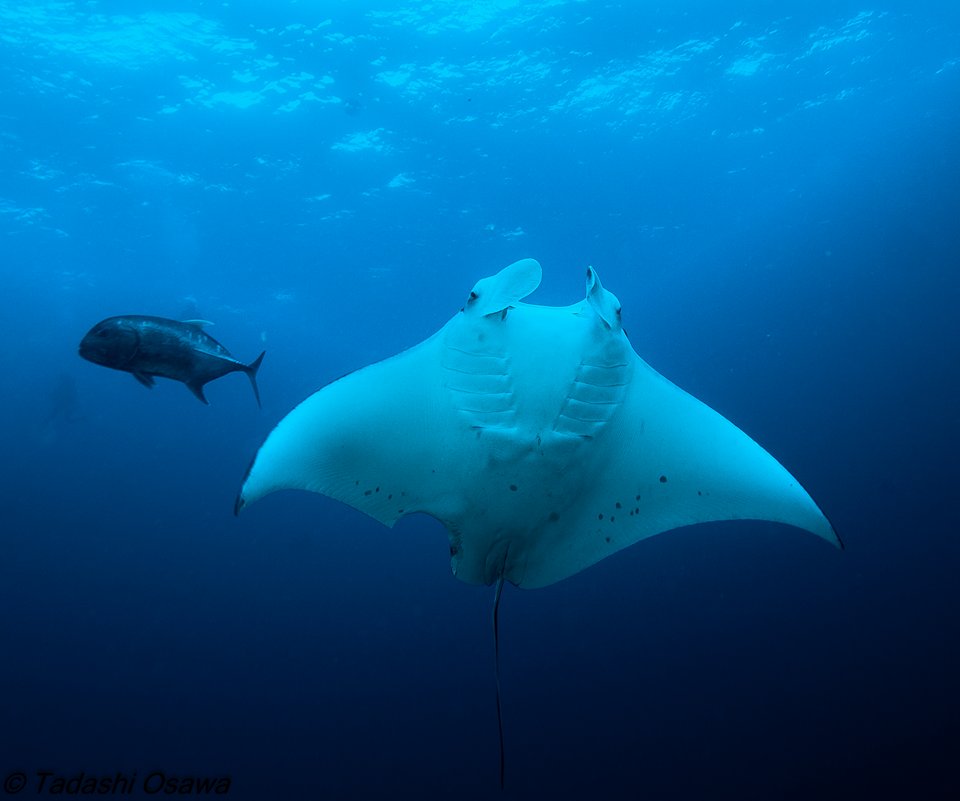

If you have been diving with Manta Rays in Thailand before, you will almost certainly have dived with a Giant Manta Ray. For anyone diving on the MV Hallelujah on 24th November 2017, you guys saw something special! But where did it come from?
The 2 (or 3) types of Manta Ray
How many types of Manta Ray are there? The answer is actually quite complicated. The short answer is two ….. or three? Until fairly recently there was only thought to be one species of Manta. It was not until 2009 that Dr.Andrea Marshall, the world’s leading expert on Manta rays, re-evaluated the genus into 2 separate species. They were the Giant Manta (Manta Birostris) and the reef Manta (Manta Alfredi). Dr. Marshall, from the Marine Megafauna Foundation, is currently researching a third species of Manta Ray in Mexico. However, things get even more complicated.
Manta or Mobula?
So how many types of Manta Ray are there? Well, technically the answer could also be zero! A comprehensive study recently discovered that the genetic differences between the Manta Ray and the Mobula Ray were a lot less than previously thought. This resulted in the taxonomic reclassification of Mantas to Mobulas. The ‘Manta Birostris‘ (Giant) is technically now the ‘Mobula Birostris‘. The ‘Manta Alfredi‘ (Reef) is now the ‘Mobula Alfredi‘. But even scientists can be sentimental. It is likely that the common names of Giant Manta and Reef Manta will be around for a long time. The third species in Mexico is yet to be officially confirmed.
Differences between the Giant and Reef
As the names suggest, one of the biggest differences is that the Giant Manta Rays can grow much larger. However, this is not always the best way to tell them apart as a juvenile or smaller Giant Manta could be smaller than a fully grown adult Reef Manta. The easiest way to tell is by the colour patterns and spot markings.

The spot patterns on Mantas can be used to differentiate not only the species, but also an individual Manta Ray. These spots are their fingerprints. These images are taken from Manta Matcher. This excellent website allows divers to upload photos of Mantas to their database and they can tell you if the Manta has ever been seen before or if it is a new discovery.
As you can see there is a clear difference between the Giant and the Reef Manta. A reef Manta’s spots can be spread all across the underside, whereas the spots on a Giant are much more central. Compare this to the photos of the Manta seen at Koh Tachai on 24th November and you can clearly see that this was a Reef Manta.
Why is this Manta Ray special?
First of all we would like to give a big thank you to Tadashi Osawa for his excellent identification photos. Tadashi is a long time guest of Big Blue Diving Khao Lak and dives with us every year. This year he has been fortunate enough to get these very special photos.
There are usually no Reef Mantas in Thailand. There has only ever been one recorded sighting of a Reef Manta in Thailand. This occurred a couple of years ago at Koh Bon. The nearest populations of Reef Mantas are in the Andaman Islands or Indonesia. So wherever it came from, this Manta has traveled a very long way to get here.
Is that a shark bite?
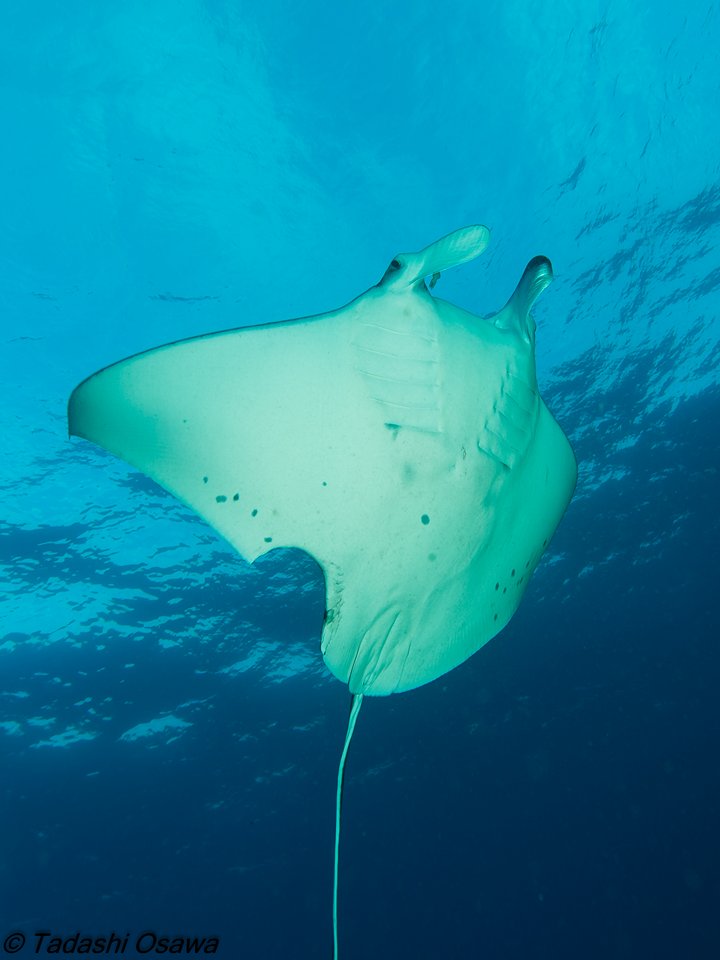
After sending the photos off to our friends at Manta Matcher, we can tell you a few other fascinating facts. Firstly, he is a juvenile male. Secondly, the big hole in its wing is most likely a bite from a Bull shark. It is not a recent bite as you can see it has healed already. Once the photos have been processed through the database we will find out if he has been spotted before and where. As it is young, this may be the first time it has been sighted.
Diving with Manta Rays in Thailand
We will update you as soon as we find any more information. Exciting times in the Similan Islands, and we are only just at the start of the season! Contact us if you are interested in diving with Manta Rays and we can tell you how to increase your chances. We can also teach you how to take identification photos so you can contribute to science.