
The idea for this trip report, Hallelujah #106 came about from the feedback we get from guests on conclusion of each Similan liveaboard we run. As well as handling comments and suggestions on board, I always recommend that guests relay this information to our office on the feedback forms. One instance of this I was told that the forms were a waste of time and no one in the office would read them.
We do read the feedback and always strive to improve our Similan liveaboard service wherever possible, but more about this later. Right now I want to tell you more about some of the unique species we sometimes see underwater when diving the Similan Islands. Thanks for your suggestion Molly, this one’s for you…
Diving with Giant Manta Rays
 The Andaman Sea off the west coastline of Thailand is one of the best places on the planet to dive with Giant Manta Rays. Unlike the commonly encountered Reef Manta Ray, Giant Mantas are more elusive oceanic wanderers and to date little is known about where they travel. However, from January to March every year there are high chances of spotting Giant Mantas around Koh Bon and Koh Tachai in the Similan Island National Park. More so than the whale shark encounters promised by the guide books.
Our transient Manta population is a big draw to the region but unfortunately for our trip, it is rare to encounter a Giant Manta in November. That said, the sea can always surprise as guests recently found out when a Reef Manta showed up at Koh Tachai, becoming only the second ever positively identified reef Manta in Thailand’s portion of the Andaman Sea.
Andaman Sweetlips
 One species of fish believed to be endemic to the region is the Andaman Sweetlips. Unlike other common sweetlip species found around the Similan Islands the Andaman Sweetlips leads a solitary existence, often spotted during the day time lurking under corals or under the overhangs of large boulders. This behaviour would suggest the fish feeds predominantly at night on small invertebrates in much the same manner as it’s relative, the Oriental Sweetlips.
The Andaman Sweetlips is easily identified by its white, silvery body mostly covered in a black spot like pattern, pronounced lips and large head.
Andaman Foxface
 For this blog I consulted team Japan for further species endemic to the Similan Islands. After 13 years diving here I was quite surprised with what I learned. My favourite from the suggestions is the Andaman Foxface, mainly because of the confusion it causes. The Andaman Foxface is the endemic Similan version of the more common yellow Foxface. Both of these actually have nothing to do with foxes, they are species of rabbit fish. This apparently gets big laughs during briefings in Japanese, highlighting the complexities of the English language where a fish is named after a fox that is a type of rabbit. Confusing right?
The Andaman Foxface is most easily encountered on Breakfast Bend. Something new for me to look out for as well as other fish species endemic to the area such as the Andaman Butterflyfish, Andaman Dottyback, Andaman Mimic Filefish, Andaman Triplefin, Andaman Damsel and Andaman Clingfish.
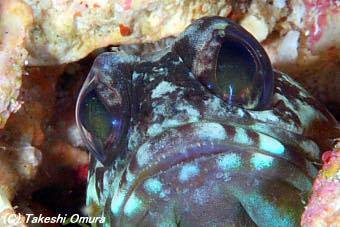
Andaman Jawfish
 Jawfish are most commonly spotted at Breakfast Bend, North Point and the Boonsung Wreck either swimming just above the sandy bottom or more likely when approached, hiding in it’s burrow in the sand. When in it’s burrow the Jawfish resembles a toad. During reproduction the male Jawfish will incubate its eggs in its mouth for protection, hence the name.
There is one type of jawfish found in the Similans area which to date remains unclassified. If you have ever fancied having a fish species named after yourself then this Jawfish name is up for grabs. You just to be able to write a scientific paper describing the new species first.
Sponge Snail
 Coriocella hibyae is a curious little creature found mostly at Koh Bon and sometimes at Koh Tachai. It is dark green in colour and resembles a sponge like blob. It can transform its body shape into what I can best describe as a series of protruding nodules.
Within the Similan diving industry this creature is often referred to as the Maldives sponge snail, as it was first described as being endemic to the Maldives in the Indian Ocean Reef Guide by Helmut Debilius. However it made such a colossal migration to the Similans we will never know.
Thanks for Your Feedback
 So to everyone who joined us on trip #106, really hope you had a good time. Always fun for us with a busy boat and sorry Molly if I didn’t get chance to tell you about the fish life above whilst on MV Hallelujah. Thanks to everyone for their feedback. David, the office did listen and we are working on getting more towels and especially making them available all warm straight after the dive. Everyone should come and check this out a dive with Manta Rays early next year 🙂