Tao One
The green turtle (Chelonia mydas) is a large, herbivorous sea turtle found in tropical and subtropical oceans worldwide. They are listed as Endangered due to threats like habitat loss, bycatch, and climate change.
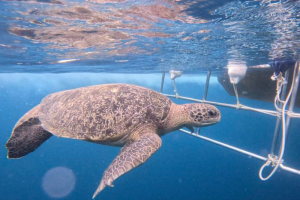

Anakin is a green turtle (ID #0004) first spotted in April 2018. This adult turtle has been sighted 12 times, contributing valuable data to our Andaman Sea conservation database through the Andaman Turtle Watch partnership.
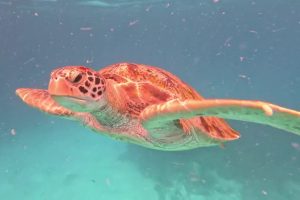
Will is a green turtle (ID #0009) first spotted in November 2024. This adult male turtle has been sighted 11 times, contributing valuable data to our Andaman Sea conservation database through the Andaman Turtle Watch partnership.
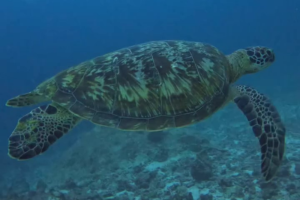
Tangmo is a green turtle (ID #0027) first spotted in February 2023. This sub-adult turtle has been sighted 12 times, contributing valuable data to our Andaman Sea conservation database through the Andaman Turtle Watch partnership.
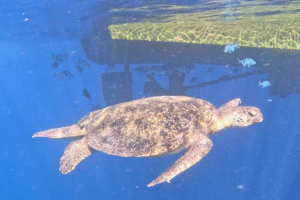
Colita (เจ้าริสแบนด์) is a green turtle (ID #0005) first spotted in 2015. This adult turtle has been sighted 8 times, contributing valuable data to our Andaman Sea conservation database through the Andaman Turtle Watch partnership.
The Green Turtle (Chelonia mydas) is one of the largest and most iconic sea turtle species, renowned for its graceful appearance and important ecological role in marine ecosystems. Named not for the color of its shell but for the greenish hue of its body fat, this gentle herbivore has a smooth, heart-shaped carapace ranging in color from olive to brown with radiating or mottled patterns.
Adult green turtles typically reach lengths of 80–120 cm and can weigh up to 150 kg or more. Unlike most sea turtles, green turtles have a single pair of prefrontal scales between their eyes and a smooth, rounded beak that reflects their plant-based diet. They are strong, long-distance swimmers and show remarkable site fidelity to nesting and foraging grounds.
Despite their size and resilience, green turtles face numerous threats and are classified as Endangered by the IUCN. Population declines are driven by egg harvesting, bycatch in fisheries, habitat loss, and diseases such as fibropapillomatosis. Conservation efforts are vital for ensuring the survival of this keystone species.
Green Turtles are found in tropical and subtropical seas worldwide, occupying a broad range of coastal habitats throughout their life stages.
Seagrass beds and algae-rich lagoons
Shallow coastal bays and estuaries
Coral reefs (especially for juveniles)
Sandy nesting beaches and barrier islands
Environmental Conditions:
Green turtles prefer warm, clear waters typically between 20–30°C (68–86°F). Their foraging habitats are usually associated with abundant seagrass and macroalgae, which support their herbivorous diet. Nesting beaches require soft sand, minimal disturbance, and stable temperatures for successful egg incubation.
Widespread in the Atlantic, Pacific, and Indian Oceans. Major nesting sites include Costa Rica, the eastern Mediterranean, Australia, Oman, and the Philippines. Some of the largest breeding populations are found in the Great Barrier Reef, Tortuguero (Costa Rica), and Raine Island.
Green Turtles undergo a major dietary shift as they mature, making them one of the few herbivorous sea turtle species in adulthood.
Jellyfish, small invertebrates
Crustaceans and fish eggs
Algae and seagrass
Sponges and other soft-bodied organisms
Primarily seagrasses (e.g., Thalassia, Halodule)
Marine algae (red, green, and brown species)
Juveniles are omnivorous and opportunistic, but adults shift to a strictly herbivorous diet — a rarity among reptiles. This grazing behavior promotes healthy seagrass beds by preventing overgrowth and encouraging nutrient cycling. Green turtles feed mostly during daylight hours and use their sharp-edged jaws to shear vegetation from the substrate.
Their role as ecosystem engineers is vital in maintaining the productivity and biodiversity of seagrass ecosystems, which serve as nursery grounds for numerous marine species.
Females return to natal beaches, often traveling thousands of kilometers
Nesting typically occurs at night
Females lay 3–7 clutches per season, spaced about 12–14 days apart
Preferred nesting beaches have deep, fine sand and low disturbance
Mating takes place offshore near nesting sites. After mating, females emerge onto beaches to dig nests above the high tide line, depositing around 80–120 eggs per clutch. The nests are carefully camouflaged before the female returns to sea.
Incubation takes 45–70 days, with sex determined by sand temperature (warmer nests yield more females). Hatchlings emerge primarily at night and orient toward the brightest horizon — usually the sea — though artificial lighting can cause disorientation.