Big Blue Marine Species Information

Spiny Lobster

Spiny lobsters represent one of the most successful crustacean families, comprising approximately 60 species distributed across warm seas worldwide. Distinguished by their prominent spiny antennae and absence of claws, these nocturnal reef dwellers play crucial ecological roles whilst supporting vital commercial fisheries globally.
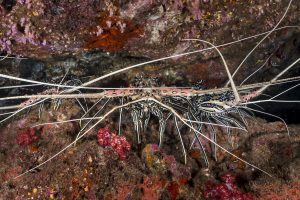
Three spiny lobsters at Koh Tachai dive site in the Similan Islands

Spined Sentinel

Huw Penson’s remarkable photograph showcases a pronghorn spiny lobster’s intricate antennae network at Koh Tachai Pinnacle, the premier site for encountering these creatures. These sophisticated crustaceans use their extraordinary sensory apparatus for chemical detection, current reading, and forming spectacular migration chains across the seafloor.

Read More Information »
Introduction

The family Palinuridae, commonly known as spiny lobsters, langustas, langouste, or rock lobsters, encompasses approximately 60 species of marine decapod crustaceans distributed across warm and tropical seas worldwide. These remarkable arthropods belong to the infraorder Achelata alongside their closest relatives, the slipper lobsters (Scyllaridae), and represent one of the most successful groups of benthic marine crustaceans.

Spiny lobsters are distinguished from true lobsters (Nephropidae) by several key morphological features: their exceptionally long, thick, spiny antennae; the absence of large chelae (claws) on their first four pairs of walking legs; and their unique phyllosoma larval stage. The family name derives from the ancient Italian port of Palinuro, renowned for harvesting European spiny lobsters during Roman times.

The 12 recognised genera include familiar names such as Panulirus (found throughout tropical Indo-Pacific and Atlantic regions), Palinurus (Mediterranean and Atlantic), Jasus (Southern Hemisphere), and Linuparus (deep-water species). Many genus names represent anagrams of Palinurus, reflecting their shared evolutionary heritage and morphological similarities.

Spiny lobsters demonstrate extraordinary ecological success, occupying diverse marine habitats from shallow coral reefs to deep continental slopes. Their economic importance cannot be overstated—they support major commercial and artisanal fisheries worldwide and represent the primary seafood export for several island nations. This combination of ecological significance and economic value makes spiny lobsters among the most studied and managed marine invertebrates globally.

Habitat

Spiny lobsters exhibit one of the most extensive global distributions of any marine crustacean family, inhabiting warm and tropical seas across all major ocean basins with remarkable habitat diversity and adaptability.

Depth Range: The family demonstrates exceptional depth range flexibility, from intertidal zones to depths exceeding 200 metres. Most species prefer shallow to moderate depths (1-50 metres), though some genera like Linuparus and Puerulus are adapted to deeper continental slope environments.
Preferred Environments:
  • Coral reefs and associated reef systems
  • Rocky shores and boulder fields
  • Seagrass beds and algal meadows
  • Continental shelves and slopes
  • Underwater caves and crevice systems
  • Sandy and rubble substrates adjacent to hard structures
Geographic Distribution:

Spiny lobsters are found in almost all warm seas, with particularly high diversity in the Indo-Pacific region. Major distribution areas include the Caribbean Sea, Mediterranean Sea, eastern and western Atlantic coasts, Indo-Pacific coral triangle, Australian and New Zealand waters, and the eastern Pacific from California to Chile. The Southern Ocean species (Jasus genus) extend into temperate waters, demonstrating the family’s adaptability to varying temperature regimes.

Spiny lobsters exhibit strong habitat fidelity to structurally complex environments that provide abundant shelter opportunities. During daylight hours, they remain concealed in crevices, caves, coral heads, or under ledges, emerging primarily at night to forage. Their choice of shelter sites is influenced by predation pressure, body size, reproductive status, and local habitat availability.

Many species demonstrate remarkable site fidelity, returning to the same shelter locations repeatedly and establishing semi-permanent territories. For divers exploring premier reef destinations during Similan diving expeditions, encounters with various spiny lobster species represent highlights of the underwater experience, showcasing the incredible diversity within this successful crustacean family.

The family shows particular abundance in areas with complex three-dimensional habitat structure, optimal water temperatures (typically 20-30°C), and strong water circulation that provides good oxygenation and nutrient transport. Different species have evolved specific habitat preferences, from shallow coral gardens to deep rocky slopes, contributing to the family’s overall ecological success.

Feeding

Spiny lobsters demonstrate diverse feeding strategies across the family, generally functioning as omnivorous scavengers and opportunistic predators with feeding behaviours that vary significantly between species, life stages, and environmental conditions.

Juvenile Diet:
  • Microscopic algae and phytoplankton
  • Zooplankton and small crustacean larvae
  • Detrital organic matter and marine snow
  • Bacterial films and biofilms
  • Small invertebrate larvae and eggs
  • Organic particles suspended in water column
Adult Diet:
  • Gastropod molluscs (snails, limpets, abalone)
  • Bivalve molluscs (clams, mussels, oysters)
  • Crustaceans (crabs, smaller lobsters, barnacles)
  • Echinoderms (sea urchins, brittle stars, sea cucumbers)
  • Polychaete worms and various marine invertebrates
  • Macroalgae and seagrasses
  • Carrion and detrital material
  • Occasionally small fish and cephalopods
Feeding Behaviour:

Spiny lobsters are predominantly nocturnal foragers, exhibiting complex feeding behaviours adapted to their respective habitats and prey availability. During daylight hours, they remain relatively inactive in shelter, emerging after sunset to commence systematic foraging activities across reef surfaces and adjacent soft substrates.

Their feeding strategy combines active hunting with opportunistic scavenging, using their highly developed chemosensory capabilities to locate food sources. The long, sensitive antennae serve dual roles as sensory organs for detecting chemical gradients and as defensive weapons against potential predators. Their robust mandibles and specialised mouthparts are well-adapted for processing diverse prey types, from crushing hard-shelled molluscs to scraping algal material from rocky surfaces.

Many species exhibit sophisticated foraging behaviours, including cooperative feeding in some Caribbean species, seasonal dietary shifts based on prey availability, and size-specific prey selection. Their feeding activities play crucial ecological roles in reef systems, controlling herbivorous invertebrate populations, recycling organic matter, and maintaining ecosystem balance through predation pressure on various invertebrate communities.

Reproduction
Sexual Maturity: Sexual maturity varies considerably across the family, typically occurring between 2-5 years of age depending on species, environmental conditions, and growth rates. Size at maturity generally ranges from 6-12 centimetres carapace length, with males often maturing at smaller sizes than females but growing to larger maximum sizes.
Breeding Season: Reproductive timing varies globally based on species and geographic location. Tropical species may reproduce year-round with peak activity during warmer months, whilst temperate species show more distinct seasonal patterns. Many species coordinate spawning with lunar cycles, seasonal temperature patterns, and food availability to optimise larval survival.
Spawning Behaviour:
  • Complex courtship rituals involving antennae contact and positioning
  • Male transfer of spermatophores to females using modified pleopods
  • Females may mate with multiple males during single reproductive cycles
  • Territorial behaviour among breeding males in some species
  • Formation of breeding aggregations in certain species
Reproductive Process:

The reproductive biology of spiny lobsters follows complex patterns that contribute significantly to their evolutionary success and wide global distribution, with all species sharing fundamental characteristics whilst exhibiting species-specific variations in timing, duration, and larval development.

Following mating, females carry fertilised eggs externally attached to their pleopods (swimmerets) for extended periods lasting several months. Egg masses, ranging from bright orange to deep red, contain hundreds of thousands of individual eggs that are actively tended through regular cleaning and aeration activities. Development time varies with water temperature, typically lasting 3-8 months depending on species and environmental conditions.

Larval Development:

Spiny lobsters undergo one of the most remarkable larval development phases in the marine realm. Upon hatching, larvae enter the phyllosoma stage—a unique, transparent, leaf-like larval form found only in the Achelata group. This planktonic phase lasts 6-24 months depending on species, during which larvae may drift thousands of kilometres with ocean currents.

The phyllosoma larvae are highly specialised for extended planktonic life, feeding primarily on gelatinous zooplankton and gradually developing through multiple moult stages. The final larval stage, called puerulus, develops swimming capabilities and actively seeks suitable settlement habitat. Upon finding appropriate substrate, typically coral reefs or rocky areas, the puerulus undergoes metamorphosis to the juvenile form.

Parental Care:

Female spiny lobsters provide extensive parental care during egg incubation, remaining in secure shelters and actively maintaining egg masses through grooming, fanning, and protection from predators and pathogens. However, once larvae hatch and enter the plankton, no further parental investment occurs, and larval success depends entirely on environmental conditions, ocean currents, and food availability.

The extended larval phase serves crucial functions in population connectivity, genetic exchange between distant populations, and colonisation of suitable habitats across vast oceanic distances. This reproductive strategy contributes significantly to the family’s remarkable global distribution and evolutionary success across diverse marine environments.

2026 - 2027 SIMILAN DIVING SEASON - EARLY BIRD DISCOUNT

SAVE 10% + BOOK NOW, PAY LATER

10% off all cabin prices when you book 2026-2027 now. Just 20% deposit secures your spot—full balance not due until 1st October 2026.