Big Blue Marine Species Information

Scribbled Filefish

The Scribbled Filefish (Aluterus scriptus) is one of the ocean’s most accomplished masters of disguise, capable of rapid colour and pattern changes to blend seamlessly with its surroundings. These elongated reef dwellers inhabit tropical waters worldwide, frequenting coral reefs and sandy areas from shallow lagoons to 120 metres depth. Their unique defensive spine-locking mechanism and sophisticated camouflage abilities make them fascinating subjects for marine biologists and popular encounters for underwater photographers seeking unique reef species.
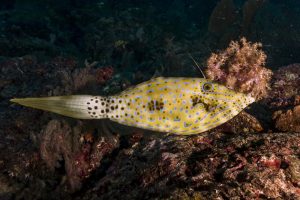
Scribbled filefish at Koh Tachai dive site in the Similan Islands National Park

Scribbled Excellence

This captivating image captures a scribbled filefish displaying its characteristic golden body adorned with intricate blue and black spots against a backdrop of colourful coral formations. These remarkable fish are masters of camouflage, capable of rapidly changing their appearance to blend seamlessly with their reef environment, making encounters like this a special highlight of any diving expedition.

Read More Information »
Introduction

The Scribbled Filefish (Aluterus scriptus) is a widely distributed marine fish species belonging to the filefish family Monacanthidae. Also known as the Scrawled Filefish in some regions, this species is distinguished by its remarkable camouflage abilities, elongated body shape, and distinctive spotted pattern that gives rise to its common name. The scientific name ‘scriptus’ refers to the script-like markings that cover much of the body, resembling handwritten text.

These fish are characterised by their laterally compressed, oval-shaped bodies, small terminal mouths, and the prominent first dorsal spine that can be locked erect as a defensive mechanism. Unlike many reef fish that rely primarily on speed for escape, scribbled filefish have evolved sophisticated camouflage and defensive strategies that allow them to survive in diverse marine environments.

Scribbled filefish play important ecological roles as both predators of small invertebrates and algae grazers, helping to maintain balance within coral reef and seagrass ecosystems. Their unique morphology, behaviour patterns, and wide distribution have made them subjects of considerable scientific interest, particularly regarding their colour-changing abilities and adaptive camouflage strategies.

Habitat

Spotted Porcupinefish demonstrate one of the widest distributions among reef fish species, inhabiting tropical and subtropical waters across the globe.

Depth Range: Commonly found at depths of 3-50 metres (10-164 feet), though they occasionally venture into deeper waters up to 200 metres.
Preferred Environments:
  • Coral reefs and fringing reef systems
  • Rocky substrates and boulder fields
  • Lagoons with coral patches and sandy areas
  • Seagrass beds adjacent to reef systems
  • Coastal waters with moderate currents
Geographic Distribution:

Their range encompasses tropical waters worldwide, including the Indo-Pacific from the Red Sea and East Africa to the central Pacific, throughout the Caribbean and western Atlantic, and in the eastern Pacific from California to Ecuador. They prefer areas with stable water temperatures between 22-28°C (72-82°F) and good water quality.

Microhabitat Preferences:

During daylight hours, Spotted Porcupinefish typically seek shelter in caves, crevices, or under coral overhangs. Juveniles often remain closer to protective cover, whilst adults may venture into more open areas. They demonstrate site fidelity, often returning to the same shelter locations. Areas with mixed substrates providing both hunting grounds and shelter are particularly favoured.

Feeding

Spotted Porcupinefish are highly specialised predators with feeding adaptations that allow them to exploit hard-shelled prey:

Juvenile Diet:
  • Small crustaceans and hermit crabs
  • Juvenile molluscs with softer shells
  • Marine worms and polychaetes
  • Small sea urchins and brittle stars
Adult Diet:
  • Large sea urchins and crown-of-thorns starfish
  • Hard-shelled molluscs (gastropods and bivalves)
  • Crustaceans including crabs and large barnacles
  • Coral polyps and calcareous algae
Feeding Behaviour:

Spotted Porcupinefish are primarily nocturnal feeders, emerging from their daytime shelters at dusk to hunt. They possess powerful, fused teeth forming a beak-like structure capable of crushing extremely hard materials. Their pharyngeal teeth provide additional processing power for breaking down shell fragments.

Feeding Strategies:

These fish employ a deliberate hunting approach, methodically searching reef surfaces and crevices for prey. They use their excellent eyesight and sensitive lateral line system to locate hidden prey items. When attacking sea urchins, they approach from above or below to avoid the defensive spines, often consuming the entire organism including the test (shell). Their feeding activity plays a crucial role in controlling sea urchin populations and preventing overgrazing of coral reefs.

Reproduction
Sexual Maturity: Spotted Porcupinefish typically reach sexual maturity at 2-4 years of age, corresponding to a total length of approximately 15-20 cm, though this varies with geographic location and environmental conditions.
Breeding Season: Spawning occurs during warmer months when water temperatures are optimal and food abundance peaks. In tropical regions, breeding may occur year-round with peaks during spring and summer months.
Spawning Behaviour:
  • They are broadcast spawners with external fertilisation
  • Spawning typically occurs at dusk or during nighttime hours
  • Males may establish temporary territories around suitable spawning sites
  • Courtship involves circular swimming patterns and inflation displays
  • Group spawning events may occur when population densities are high
Reproductive Process:

Females release thousands of spherical, pelagic eggs that measure approximately 2-2.5mm in diameter. Males simultaneously release sperm clouds to fertilise the eggs externally. The transparent, buoyant eggs float in the water column for 4-7 days depending on water temperature before hatching.

Larval Development: The larval stage extends for 6-8 weeks, during which the young fish are planktonic and feed primarily on copepods and other small zooplankton. Larvae undergo significant morphological changes, gradually developing their characteristic spines and spotted pattern. The inflation capability develops during the juvenile stage as the specialised muscles and internal structures mature.
Parental Care: Like most marine broadcast spawners, Spotted Porcupinefish provide no parental care after spawning. Reproductive success depends heavily on environmental conditions, predation pressure, and the availability of suitable food sources for developing larvae. Settlement occurs when juveniles reach approximately 2-3 cm in length, at which point they seek appropriate reef habitat and begin their benthic lifestyle.