Big Blue Marine Species Information

Red Sea Fan

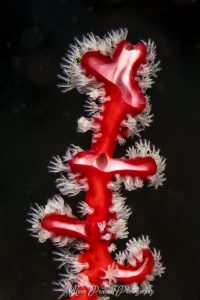
The red sea fan is a striking gorgonian coral distinguished by its vibrant crimson coloration and intricate branching structure. These colonial cnidarians create elegant underwater sculptures whilst filtering plankton from tropical reef waters through thousands of coordinated polyps.
Stunning soft coral at Richelieu Rock

Ruby Red

Huw Penson’s mesmerising image captures a red sea fan in full feeding display at Richelieu Rock, showcasing the coral’s intricate branching structure adorned with countless extended polyps. These flexible gorgonian colonies create some of the reef’s most elegant underwater sculptures, swaying gracefully with the currents whilst filtering plankton from the water.

Read More Information »
Introduction

The Red Sea Fan (Iciligorgia rubra) is a distinctive gorgonian coral belonging to the soft coral family Gorgoniidae. This species represents one of the more visually striking members of the alcyonarian corals, characterised by its vibrant red coloration and intricate branching patterns that create some of the reef’s most elegant three-dimensional structures. The genus name “Iciligorgia” reflects the coral’s ice-like translucent polyps contrasted against its warm-coloured skeleton.

Red sea fans are colonial organisms composed of hundreds to thousands of individual polyps connected by living tissue and supported by a flexible internal skeleton made of gorgonin, a specialised protein similar to keratin. This remarkable structural adaptation allows the colony to bend and flex with strong currents without breaking, whilst maintaining the precise geometric arrangement necessary for efficient filter feeding.

These corals play crucial ecological roles in reef ecosystems, providing three-dimensional habitat structure for small fish and invertebrates whilst contributing to nutrient cycling through their filter-feeding activities. Their striking appearance and photogenic qualities have made them popular subjects among underwater photographers and marine aquarium enthusiasts, though wild collection is increasingly regulated due to conservation concerns.

Habitat

Red sea fans inhabit tropical and subtropical waters throughout the Indo-Pacific region, demonstrating preferences for areas with strong water movement and high nutrient availability that support their filter-feeding lifestyle.

Depth Range: Typically found at depths of 10-40 metres (33-131 feet), with optimal growth occurring in the 15-30 metre range where light conditions and water movement create ideal conditions for both the coral and its symbiotic zooxanthellae.
Preferred Environments:
  • Steep reef slopes and walls with strong currents
  • Channel entrances and passages between reef structures
  • Areas with consistent water flow and nutrient transport
  • Hard substrates suitable for larval settlement and attachment
  • Clear tropical waters with stable salinity levels
Geographic Distribution:

The species occurs throughout the tropical Indo-Pacific, including the Red Sea, Indian Ocean, and western Pacific regions. In Southeast Asian waters, they are found around Indonesia, Malaysia, Thailand, and the Philippines, with notable populations around prominent dive sites where strong currents create optimal feeding conditions.

Red sea fans require specific environmental conditions to thrive, including water temperatures between 25-29°C (77-84°F), stable salinity levels, and most importantly, consistent current flow that brings planktonic food sources within reach of their feeding polyps. They show particular abundance at sites with upwelling currents or tidal flows that concentrate nutrients.

For divers exploring these remarkable reef systems during Similan diving expeditions, red sea fans represent highlights of deeper reef exploration, often forming spectacular underwater gardens on current-swept walls and pinnacles where their feeding requirements are optimally met.

Feeding

Red sea fans are sophisticated filter feeders with feeding strategies that combine passive particle capture with active prey selection, representing one of the most efficient feeding systems in the coral reef ecosystem.

Juvenile Diet:
  • Microscopic phytoplankton and bacterial particles
  • Dissolved organic matter from seawater
  • Small zooplankton larvae and copepod nauplii
  • Organic detritus and marine snow
  • Nutrients from symbiotic zooxanthellae photosynthesis
Adult Diet:
  • Zooplankton including copepods, mysid shrimp, and larvae
  • Phytoplankton and unicellular algae
  • Organic particles and detrital material
  • Dissolved nutrients and amino acids from water column
  • Photosynthetic products from symbiotic algae
Feeding Behaviour:

Red sea fans employ a sophisticated feeding strategy that operates continuously throughout the day and night cycle. Each polyp functions as an individual feeding unit whilst being connected to the colony’s shared digestive system, creating a highly efficient nutrient distribution network.

During feeding, polyps extend their tentacles into the water column, creating a fine mesh that captures passing particles through specialised stinging cells called nematocysts. The coordinated action of hundreds of polyps creates a living filtration system that can process large volumes of water. Particles are sorted at the polyp level, with suitable food items being transported to the gastrovascular cavity for digestion whilst unsuitable material is rejected.

The colonies also maintain symbiotic relationships with zooxanthellae algae, which provide additional nutrition through photosynthesis. This dual feeding strategy allows red sea fans to thrive in nutrient-poor tropical waters by supplementing filter feeding with internally produced organic compounds.

Reproduction
Sexual Maturity: Red sea fan colonies typically reach reproductive maturity after 3-5 years of growth, when colonies have achieved sufficient size and polyp density to support gamete production. Colony size rather than age often determines reproductive readiness.
Breeding Season: Reproductive activity generally occurs during warmer months, often coinciding with lunar cycles and seasonal temperature patterns. In tropical regions, spawning may occur multiple times per year, typically triggered by combinations of temperature, lunar phase, and tidal conditions.
Spawning Behaviour:
  • Simultaneous hermaphroditic reproduction (colonies produce both eggs and sperm)
  • Coordinated mass spawning events triggered by environmental cues
  • Release of gamete bundles containing both eggs and sperm
  • External fertilisation occurring in the water column
  • Spawning typically occurs during evening hours following full moon periods
Reproductive Process:

The reproductive biology of red sea fans follows complex patterns typical of gorgonian corals, involving both sexual reproduction through spawning events and asexual propagation through colony fragmentation and growth.

Red sea fans are simultaneous hermaphrodites, with individual polyps capable of producing both male and female gametes. During spawning events, colonies release bundles of eggs and sperm that break apart at the water surface, allowing cross-fertilisation between different colonies.

Fertilised eggs develop into planula larvae within 12-24 hours, beginning a planktonic phase that can last several days to weeks depending on environmental conditions. These larvae are capable of limited swimming and show positive responses to chemical cues that indicate suitable settlement habitat.

Larval Development: Planula larvae undergo a critical settlement phase where they must locate appropriate hard substrate for attachment. Once settled, larvae metamorphose into primary polyps and begin the process of colonial growth through asexual budding. Initial growth is slow, with young colonies focusing on establishing secure attachment and developing sufficient polyp numbers for effective feeding.
Parental Care: Like most cnidarians, red sea fans provide no parental care after gamete release. Reproductive success depends entirely on environmental conditions, larval survival during the planktonic phase, and successful location of suitable settlement habitat. Colony fragmentation through storm damage or other disturbances can also result in asexual reproduction, with broken fragments capable of reattaching and developing into new colonies under favourable conditions.