Big Blue Marine Species Information

Giant Moray Eel

The Giant Moray Eel is the largest moray species in the Indo-Pacific, reaching over 3 metres in length. These apex predators use dual jaw systems and sophisticated hunting strategies to dominate coral reef ecosystems. Their protogynous hermaphrodite reproduction and extended larval development make them fascinating subjects for marine biologists and underwater enthusiasts exploring sites like the Similan Islands.
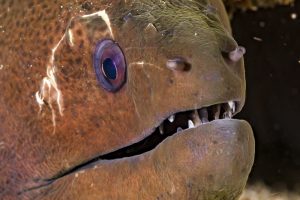
Giant moray eel seen at Koh Tachai dive site in the Similans

Violet Gaze

Huw Penson’s remarkable portrait captures the piercing violet gaze and impressive dental array of a giant moray eel at Koh Tachai Pinnacle. These master predators use dual jaw systems and serpentine camouflage to dominate their rocky reef territories throughout the Similan Islands.

Read More Information »
Introduction

The Giant Moray Eel (Gymnothorax javanicus) stands as the undisputed titan of the moray eel family, representing one of the most formidable predators in tropical reef ecosystems. This massive species can achieve extraordinary proportions, with the largest recorded specimens exceeding 3 metres in length and weighing more than 30 kilograms, making them true giants of the underwater world.

What truly sets giant morays apart is their sophisticated dual-jaw feeding mechanism. Unlike most fish, they possess a second set of pharyngeal jaws located deep within their throats, which can be projected forward to seize and drag prey into their gullets. This alien-like adaptation, combined with their muscular serpentine bodies and razor-sharp teeth, makes them extraordinarily efficient hunters capable of tackling prey as large as reef sharks and octopi.

Their perpetually open mouths, often mistaken for aggressive posturing, are actually essential for respiration, as they continuously pump water across their gills. These intelligent predators have been observed displaying complex behaviours including cooperative hunting with other species and remarkable problem-solving abilities when pursuing elusive prey.

Habitat

Giant Moray Eels inhabit the warm tropical and subtropical waters of the Indo-Pacific region, with their range extending from the Red Sea and East Africa through Southeast Asia to the central Pacific islands.

Depth Range: Typically found from shallow lagoons at 1 metre depth down to 46 metres (3-150 feet), with most encounters occurring between 5-30 metres.
Preferred Environments:
  • Coral reef systems with extensive cave networks
  • Rocky outcrops and boulder formations
  • Lagoon patch reefs with sandy channels
  • Steep drop-offs and wall formations
  • Areas with strong tidal currents bringing abundant prey
Geographic Distribution:

Their range encompasses the Indian Ocean from East Africa to Thailand, including the Maldives, Sri Lanka, and throughout Southeast Asian waters. In the Pacific, they extend from Indonesia and the Philippines to Hawaii, Fiji, and the Great Barrier Reef. Prime viewing locations for Similan diving enthusiasts include the dramatic pinnacles and swim-throughs of sites like Elephant Head Rock and Christmas Point.

Giant morays require stable water temperatures between 24-30°C (75-86°F) and prefer areas with excellent water clarity and moderate to strong currents. They establish permanent territories centred around suitable cave systems or crevice networks that provide both hunting bases and secure retreat areas.

Feeding

Giant Moray Eels are apex predators with sophisticated hunting strategies that evolve significantly as they mature:

Juvenile Diet:
  • Small reef fish and juvenile species
  • Crustaceans including crabs and shrimp
  • Cephalopod molluscs (small octopi and squid)
  • Marine worms and polychaetes
Adult Diet:
  • Large reef fish including parrotfish, groupers, and snappers
  • Cephalopods up to substantial size (octopi, cuttlefish, squid)
  • Other eels and snake eels
  • Small sharks and rays
  • Spiny lobsters and large crabs
Feeding Behaviour:

Giant morays are primarily nocturnal hunters, emerging from their daytime refuges during twilight hours to patrol their territories. Their hunting strategy combines stealth, patience, and explosive strikes. They use their acute sense of smell and electroreception to locate prey hidden in crevices and coral formations.

Their unique pharyngeal jaw system allows them to tackle prey that would be impossible for other predators of similar size. When striking, they can project these secondary jaws forward with lightning speed, grasping prey and retracting it deep into their throat where it cannot escape.

These intelligent predators have been documented engaging in cooperative hunting behaviour with coral trout and other reef predators, demonstrating remarkable interspecies communication and strategic thinking.

Reproduction
Sexual Maturity: Giant Moray Eels reach sexual maturity relatively late, typically at 4-6 years of age when they achieve lengths of approximately 1-1.5 metres.
Breeding Season: Spawning occurs during warmer months, generally from April through September in most of their range, coinciding with peak water temperatures and optimal food availability.
Spawning Behaviour:
  • They are protogynous hermaphrodites, beginning life as females and changing to males later
  • Sex change typically occurs when individuals reach 1.5-2 metres in length
  • Spawning takes place in open water above reef systems
  • Males establish temporary territories and court females through elaborate swimming displays
  • Courtship involves intertwining bodies and synchronised swimming patterns
Reproductive Process:

Females release hundreds of thousands of pelagic eggs into the water column, which are simultaneously fertilized by males. The eggs are transparent, buoyant, and approximately 1.5mm in diameter, drifting with oceanic currents for 24-36 hours before hatching.

Larval Development: Giant moray larvae undergo one of the longest larval stages among reef fish, remaining planktonic for 6-12 months. They develop into distinctive leptocephalus larvae – transparent, leaf-shaped organisms that bear little resemblance to adult morays. During this extended pelagic phase, they feed on marine snow, small planktonic organisms, and organic particles.

The transformation from leptocephalus to juvenile moray is dramatic, involving significant morphological changes as they settle onto reef systems and begin their benthic lifestyle.

Parental Care: Like all moray eels, giant morays provide no parental care following spawning. The extended larval period serves as a natural dispersal mechanism, allowing populations to maintain genetic connectivity across vast oceanic distances.